
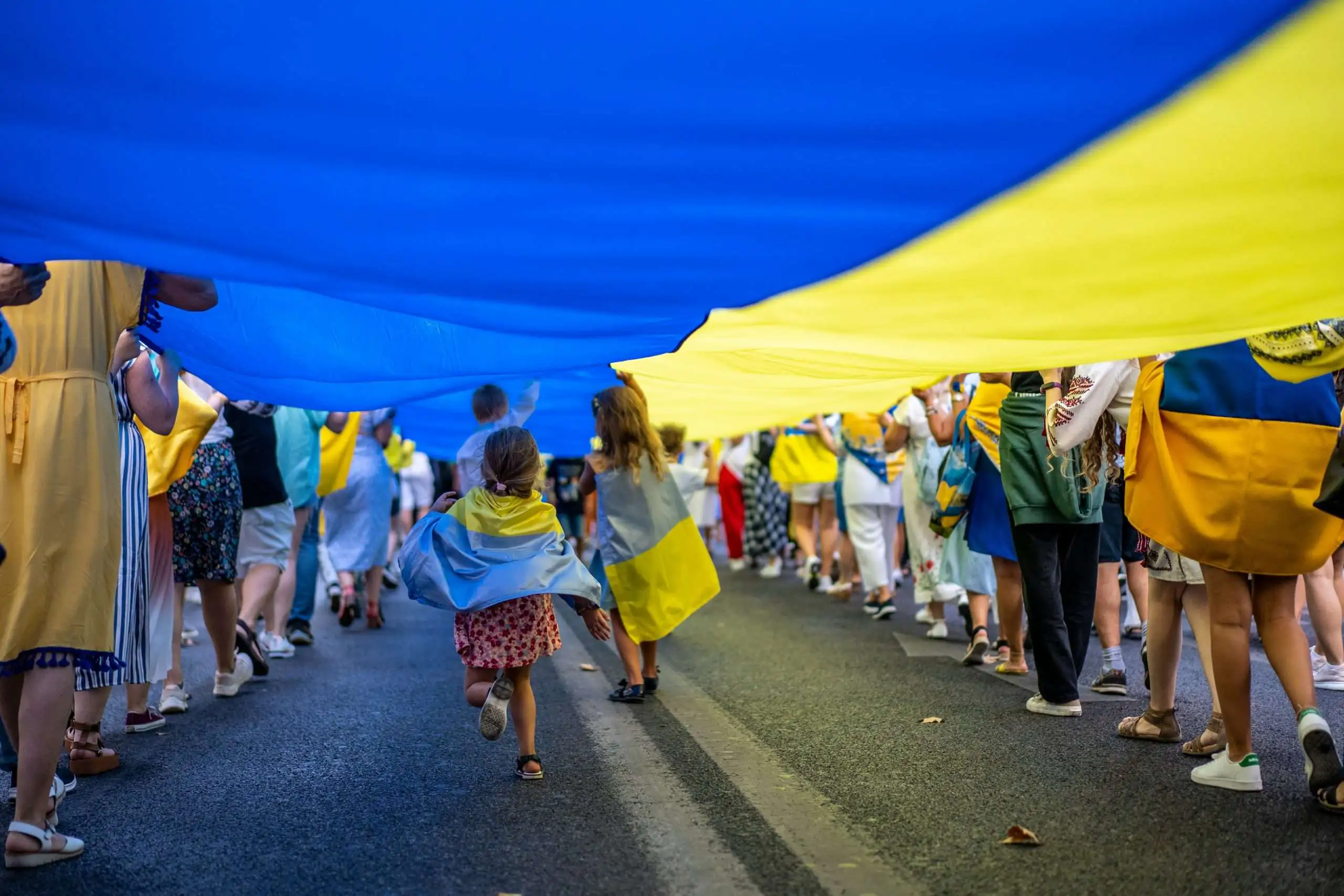
One of the participants in the research project Caring to survive, surviving to care told EuroNewsWeek about the first results of a study on how Ukrainian women build resilience in wartime.
Since Russia’s full-scale invasion of Ukraine began in February 2022, over 1.8 million women and girls have been internally displaced, and only half are employed.
Maria is a “reproductive labor” activist in Ukraine, whose team is a pillar of survival and resistance, and a binding force amidst the ongoing war with Russia. Women across Ukraine have formed organized communities, providing critical, informal services including “support groups, shared kitchens, makeshift schools, organized children’s activities, correspondence with soldiers, and aid collections.”
“The women’s reproductive labor work across the war-torn cities, make survival possible, and help create and operate temporary shelters and humanitarian aid centers. Our work is not ‘heroic’ in the usual sense, not officially recognized, and not paid. This is reproductive labor: care, support, coordination, adaptation, recovery,” says Maria. “Our work does not appear in the news, yet it has become the backbone of resistance and life itself. All this is carried on women’s shoulders — without institutional support, without days off, and without any gratitude.”
The makeshift survival mechanism has laid the post-war “foundations of a future society in which care is recognized as a fundamental social good,” explains Maria. Every day, “millions of Ukrainian women are doing the impossible” beyond surviving; they are the anchors “holding together the lives of their families, communities, and the country.”
Maria describes how the “exhausting” reproductive labor involves caring for the traumatized children, the elderly, and the sick. It includes accompanying relatives and the elderly to doctors’ appointments, cooking and cleaning, and ensuring safe hygiene while organizing shelters and temporary housing for the nearly four million displaced Ukrainians. In addition to distributing direly needed humanitarian aid to the frontline and other affected city residents, the women provide psychological and emotional support. With chaos often inflicting chaos across war-torn cities, Maria’s team maintains order within the bombed and battle-scarred communities.
War’s Silent Impact on Women and Girls
“Our work has only intensified and grown more complicated since the war began, especially against the backdrop of destroyed infrastructure and weakened social support systems. Women face daily shortages of resources, burnout, trauma, and systemic invisibility,” Maria says.
With nearly 6.7 million women needing humanitarian assistance, some 640,000 women and girls in Ukraine will be affected by cuts to psychosocial support, gender-based violence services, safe spaces, and economic empowerment programs, with the U.S. ending practically all financial contributions to the UN reproductive and sexual health agency (UNFPA).
Maria’s team helps “preserve and teach cultural and family knowledge” to Ukraine’s war-affected children since over 3 million children have been displaced from their homes since Russia’s 2022 invasion. The Ukrainian Ministry of Education and Science reports that nearly 4.6 million children in Ukraine face “barriers to education”– and two million children’s schools are closed.
Self-Organization and Shifting Gender Roles
For most women living across Ukraine’s war zone, mornings begin with check-ins.
“Is everyone alive? Is there water, electricity, and a phone connection? Then comes cooking for the family and neighbors at the shelters, washing clothes, helping a child with online learning, picking up humanitarian aid or medicine, changing bandages for my mother, talking to a friend in the middle of a panic attack, searching for rumors about the next shelling,” Maria lists the endless tasks.
Evenings are shrouded in “silence, anxiety, exhaustion” before the next morning’s tasks start all over again. Every day is “filled with care, fear, and dire lack of support.”
Across Ukraine’s war zone, shifting gender roles have exacerbated the women’s lives, who can no longer rely on husbands who are at the frontlines, have died, or have returned from the frontlines, traumatized.
“Today, women are often the sole caregivers, heads of households, volunteers, and moral anchors for their families and communities. They assume responsibilities that were once shared: they work, care, protect, negotiate with local authorities, teach children, find food, and support exhausted and traumatized neighbors,” Maria says.
While women are pivotal to the survival of their families, neighbors, and communities, the lack of access to medical and psychological care is compounded by the financial pressures with a nearly 12 percent unemployment rate.
“Women bear the burdens that exceed physical and emotional limits and the risks of violence and discrimination, moral isolation, and the impossibility of ‘stepping out of the role,’ says Maria.
In February, UN Ukraine reported that “an entire generation of Ukrainian women” has been pushed “backwards” with over 3,799 women and 289 girls killed (actual numbers are most likely much higher).
The Invisible Caregivers: Youth and Adolescents
Teenagers, especially girls, engage in caring for younger siblings and supporting the women with countless chores. But their “emotional state is often ignored,” says Maria.
“War steals their childhood, forcing them to grow up too quickly, without proper attention to their own personal feelings. The trauma of loss is also not discussed – when loved ones are killed, disappear, or leave. Women are left alone with their children, elderly parents, and the burden of heavy responsibility. Amid all this, women continue to serve as support pillars, but often at the cost of their own health.”
The unspoken loss, trauma, and burnout are underpinned and unacknowledged by “the psychological and physical exhaustion of women living in constant anxiety.” This includes the “sharp rise in domestic violence, especially in families displaced or deprived of income,” says Maria.
Following Russia’s full-scale invasion, there was a 51% increase in registered cases of domestic violence. In 2024, reported cases increased by nearly 80% over the previous year, as reported by Irina Shurkhno, head of the Department for Combating Domestic Violence at the Office of the Prosecutor General. Out of the 8,185 reported criminal domestic violence offenses, women and children accounted for the majority of the over 5,000 individuals injured.
Individual Survival Hinges on Collective Protection
To ease the burden on the women and to recognize reproductive labor’s impact during and after the war, Maria believes that the fundamental needs must be addressed and include a “funded system of support to provide access to psychologists, social workers, and compensation for caregivers.” Furthermore, “international solidarity and visibility,” and recognition of ‘care work,’ are vital to the overall national recovery in a post-war era as is “women’s active involvement in Ukraine’s future decision-making, and providing women and their children “guaranteed safety, housing, and education.”
“The wartime reproductive labor of the Ukrainian women is not only about caring for others — it is a struggle to preserve the very meaning of life. It is a quiet, but steadfast revolution that demands attention, recognition, and support. Not because women ‘can handle it,’ but because they should not have to bear it all alone,” says Ukrainian reproductive labor activist, Maria.