
The research project “Caring to survive, surviving to care” focuses on grassroots practices of social reproduction in Ukraine that could become an important component of a just post-war reconstruction.
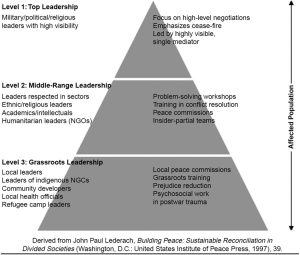
However, will such proposals be heard? One of the project’s authors, Agnieszka Fahl-Dutra Santos, addresses similar issues in her academic article “Building Trust Through Care: A Feminist Take on Inclusion in Multi-Track Mediation”, examining the cases of Armenia, Azerbaijan, and Georgia. In these countries, significant challenges emerged in building trust and interaction between official actors and grassroots participants in post-conflict peace processes.
Applying a multitrack framework to my analysis, I posit that when non-official and grassroots (Track Two and Three) actors do not have faith in, nor support, the official (Track One) peace process, a critical tension emerges, threatening the underlying logic of a peace process, the author says.
The splits were caused by domestic politics or external influences, such as the attempt to pass a law on foreign agents in Georgia. Or the significant trauma of the war and the emergence of disagreements against this background within the grassroots communities themselves, as happened in Armenia. Also typical were attempts to marginalize the proposals of grassroots participants that contradicted the official discourse. The interviewed women activists from these countries noted that in the 1990s and early 2000s, ‘there were prospects for confidence-building, many groups created to promote dialogue, economic measures. Civil society was participating – but it was a very short period.’
At the same time, the author concludes that even in the absence of trust between the participants in the process and a shared vision, ‘we need to think beyond the peace agreement, and even beyond simply reconciling the warring sides, as the ultimate objective of a peace process.’
This does not mean that a peace agreement is never useful, or that it cannot provide a valuable framework for reaching some of the peacebuilders’ goals. Indeed, peace agreements remain the main way in which conflicts are ended. However, a more comprehensive look at the plethora of spaces and processes – unfolding at the local and national level, in private and public spheres – is useful to better understand the context of the peacemaking., she says.